Where the Slippers Stop: Reading the Floors of a Japanese Inn
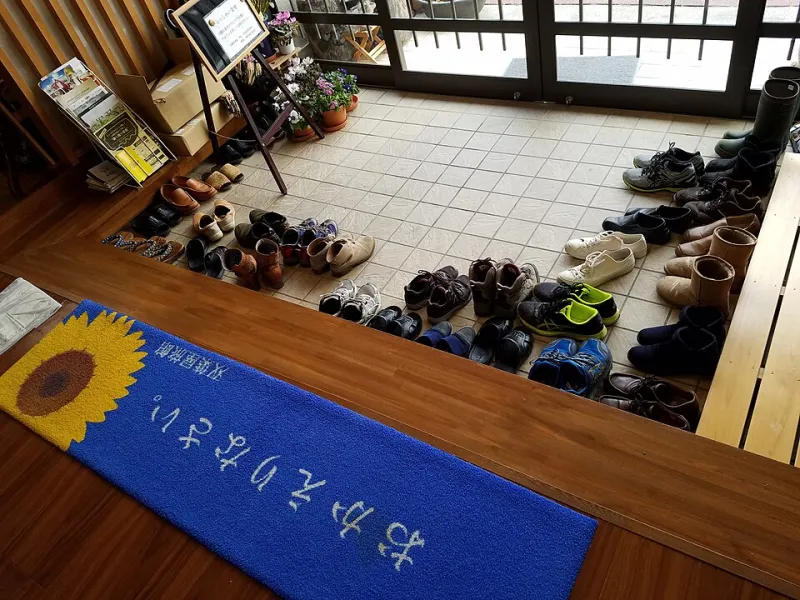
Photo: Hajime NAKANO, CC BY 2.0, via Wikimedia Commons
A Japanese inn does not ask you to remember a long list of rules. It asks you to notice the floor. Long before dinner is served or the bath is drawn, the building is guiding you through a series of transitions: from street to entryway, from entryway to corridor, from corridor to tatami, from tatami to bath. Each transition has its own footwear, or its own deliberate lack of footwear. For travelers from the United States, where shoes often stay on until bedtime, this geography can feel unfamiliar. It is not meant to be intimidating. It is a form of hospitality written at ankle height.
The Genkan: The First Sentence of the Stay
Your arrival begins at the genkan, the recessed entryway found in most Japanese homes and inns. This is not simply a place to wipe your feet. It is a threshold that separates the outside world from the inn's interior, and the distinction is taken seriously. Shoes come off here. Often, they are turned to face the door, a small courtesy that makes departure easier and signals that you have entered with care.
At a ryokan, someone will usually welcome you, take your luggage, and indicate where to leave your shoes. You may be offered house slippers. Put them on. This is not a demand for uniformity; it is the inn's way of keeping the interior clean and comfortable. The genkan is the first sentence of the stay, and it is saying: you are welcome, and you are now inside.
House Slippers Have a Boundary
House slippers belong to the inn's corridors, stairways, and public rooms. They do not belong on tatami. This is the detail that surprises many first-time guests. When you reach the edge of a tatami room, step out of the slippers and leave them neatly at the threshold. Then enter in socks or bare feet. The tatami is not a carpet; it is a living surface of woven rush, and slippers can damage it. More importantly, the room itself is treated as a more intimate zone than the corridor.
Some inns provide socks or tabi, and many guests wear their own socks on tatami. Bare feet are also common, especially in summer or in the privacy of a guest room. If you are unsure, look at what your host does, or simply leave your slippers at the room's edge and proceed in socks. No one is measuring your technique. The gesture is what matters.
The Toilet Slipper Is Not a Puzzle
The one slipper that confuses almost everyone is the toilet slipper. In many Japanese inns, a separate pair waits at the door of the toilet room. These are not for the corridor. They are for the toilet only. Step out of your house slippers, put on the toilet slippers, do what you came to do, and then step out of them before returning to the corridor. The separation is about cleanliness, not ceremony. Once you have made the transition a few times, it becomes automatic.
There is no need to apologize for pausing at the door. A brief glance down will usually tell you what is expected. If the slippers are placed neatly just inside the toilet doorway, that is your cue. If there are none, keep your house slippers on or follow the inn's posted guidance. The system is practical, and it is forgiving.
Tatami Changes the Sound of the Room
When you leave your slippers behind, you also leave behind a certain kind of noise. Tatami softens footsteps. It changes the way a room sounds and the way you move through it. This is part of the pleasure of a ryokan. You are not merely removing footwear; you are entering a quieter register of the stay.
In a guest room, this is where the inn's rhythm becomes personal. You may sit on the floor, sleep on a futon, and move between the main room and the alcove without the clip of soles. If the room has a private bath or shower, pay attention to the floor at its entrance. Often, slippers are left outside, and you step onto a washable surface or a changing area in bare feet. The principle is consistent: footwear stops where cleanliness or intimacy begins.
The Bath Is a Barefoot Country
The onsen and communal bath are perhaps the clearest example of floor etiquette. In the changing room, you will usually find a place to leave slippers, or you will remove them before entering. The bathing area itself is barefoot. This is not casual; it is practical. Wet floors, drainage, and shared washing spaces require a clean, slip-resistant surface. You wash at a low station before entering the bath, and you keep your voice low. The floor is telling you that this is a place for water, not shoes.
For American travelers, the important point is not to fear the sequence. It is to read it. If you see a line of slippers at a doorway, that is the border. If you see a raised wooden floor, that is often the signal to step up and remove shoes. If you see a small pair of slippers facing a toilet door, you know exactly what they are for.
When in Doubt, Slow Down
The most useful etiquette at a ryokan is not memorized. It is observational. Pause at thresholds. Look down. Notice where the inn has placed a mat, a step, or a pair of slippers. The staff are accustomed to guests who are new to this geography, and they will guide you without judgment. The point is not to perform perfection. The point is to accept the invitation the building is extending.
By the time you leave, the sequence will feel natural: shoes at the genkan, house slippers in the corridor, slippers off at the tatami, bare feet in the bath. None of these transitions is a test. Each is a small act of respect, and each makes the inn a little more comfortable for everyone who shares it. In a traditional Japanese inn, hospitality is not only served on a tray. It is also laid out underfoot.


