The Counterpoint Bath: Learning to Read the Cold Water at a Japanese Onsen
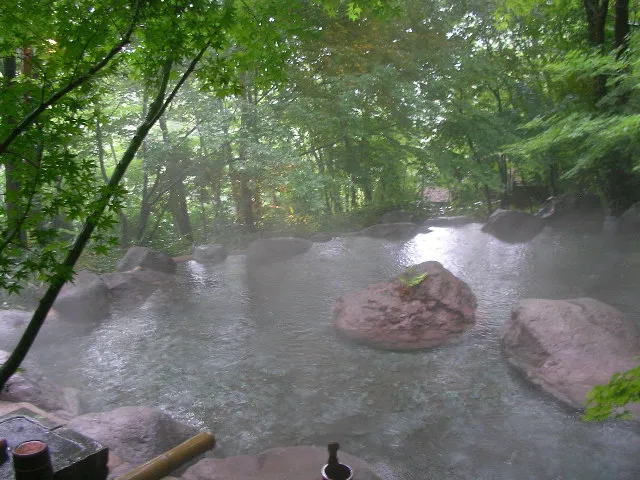
Photo: cytech from Tokyo, Japan, CC BY 2.0, via Wikimedia Commons
At the edge of a ryokan bath, usually where the floor tiles give way to stone, there is a second pool. It is smaller than the main bath and plainly unheated, and in winter its surface may carry a thin skein of steam that rises from the warm air rather than the water itself. Guests notice it, glance at it, and almost always walk past. The water looks like an afterthought.
It is not. The cold bath — the mizuburo — is one half of a pair, and at inns that take their bathing seriously, it is maintained with the same attention as the spring-fed pool beside it. For a first-time visitor, learning to use it is less about endurance than about reading the room.
What the Cold Bath Is, and What It Is Not
The mizuburo is not a lap pool, a shower substitute, or a test of character. In most traditional inns it is a small basin of unheated water, sometimes drawn from the same source as the hot bath and simply left to cool, sometimes fed by a separate cold spring. At others it is only cool rather than truly cold — a nuruyu, tepid by design, meant to be lingered in rather than flinched at.
What it is, functionally, is a reset. Japanese bathing is long. A guest may sit in a hot bath for fifteen or twenty minutes at a stretch, and the cold pool allows a body to come back to itself before returning to the heat. It is a rhythm rather than a regimen.
Why the Pairing Exists
The alternating practice is old and largely practical. Long immersion in hot mineral water raises the pulse and warms the skin; a brief passage through cooler water makes the subsequent return to the bath feel fresh again rather than enervating. In shared baths, the cold pool also serves a quieter function — it gives a heated guest somewhere to go that is not the washing station, keeping the room's traffic calm.
It is worth saying plainly that this is a matter of comfort and custom, not medicine. The claims made for contrast bathing, in Japan and increasingly in the United States, outrun the evidence. Approach the cold bath as part of how a Japanese inn is arranged, and you will not be disappointed.
Reading the Water
A well-kept cold bath announces itself. The water should be clear enough to see the bottom tiles or stones, with no film on the surface and no slickness underfoot at the rim. The stones should be free of the green-dark seam that appears when a basin is left standing for days. In winter, a covered or partially sheltered cold bath is a sign that the inn expects guests to use it in snow, not merely in June.
Look, too, for the small apparatus of care: a wooden bucket or ladle at the edge, a non-slip mat where the floor turns wet, a handrail on the steps, and occasionally a small thermometer or a posted note giving the temperature. None of these is decorative. Each represents a decision someone made about a guest they will never meet.
A neglected cold bath tells a different story. Standing water, a rim that has gone dark, a tub half-shaded by a screen nobody has moved — these suggest a pool maintained for the photograph rather than the bather. The hot bath may still be excellent. But the second temperature is a fair measure of how closely an inn watches its own rooms.
How the Regulars Use It
For a first-timer, the sensible sequence is heat, then cold, then heat again if you wish. Soak as you normally would, rise slowly, rinse at the washing station if you have been sweating, and step into the cold water for ten to thirty seconds. Exhale as you enter rather than holding your breath. Do not plunge headfirst. Do not submerge your hair in a shared bath.
Two or three rounds are ample. Most experienced bathers keep the cold segment short and the hot segment long, and they move between the two without drama — no gasping, no announcements. If the inn has an outdoor bath, the outdoor cold pool is the better choice in winter, where the air does half the work and the contrast feels less abrupt.
Etiquette at the Edge
Enter quietly and slowly, and leave the same way. The cold bath is small, often sized for one or two, and it is not the place for splashing or for conversation. Do not wash in it, do not carry soap into it, and do not linger so long that others are left standing at the rim. A brief immersion is both the custom and the courtesy.
Some inns post signs advising against the cold bath for guests with heart conditions, high blood pressure, or who are pregnant. These notices are not boilerplate. Read them, and take them seriously.
A Word on Safety
The stone around a cold bath is the most treacherous surface in the building. Move deliberately. If you feel lightheaded — and some guests do, particularly after a long hot soak or a glass of sake — sit down at the edge rather than standing, and skip the cold water entirely. Nobody at a Japanese inn will think less of you. Hydrate before and after. If you are unaccustomed to cold immersion, do not attempt it alone in a private bath, and consider mentioning your plans to your physician if you have any cardiovascular history.
The American Plunge and the Inn's Version
Stateside, cold water has become a performance metric. Plunge studios in New York and Los Angeles run timers and leaderboards; sauna-and-plunge circuits are marketed for recovery; a Minnesota winter swim is now something people photograph. There is nothing wrong with any of it, and the enthusiasm has introduced many travelers to a genuine pleasure.
But the onsen cold bath is a different animal. There is no clock, no protocol, no score. It is social in the quietest way — a shared agreement that the body has had enough heat for now — and it is governed by the room rather than by a goal. If you arrive with a recovery mindset, leave it at the changing-room door.
If You Try Only Once
Do it at the end of your last soak, not the beginning. Fifteen seconds is enough. Step out, sit on the stool at the washing station, and let the warmth return on its own. In winter, with snow on the stones and steam coming off your shoulders, the sensation is one of the more memorable things a Japanese inn offers — not because it is extreme, but because it is measured.
The second temperature is a small lesson in restraint. The hot bath asks you to stay; the cold bath asks you to know when to leave. Both are part of the same hospitality.


